Save The Pets
- 4.3
- Rating
- 50.00M
- Installs
- Free
- Price
 Analysis by App-foxy
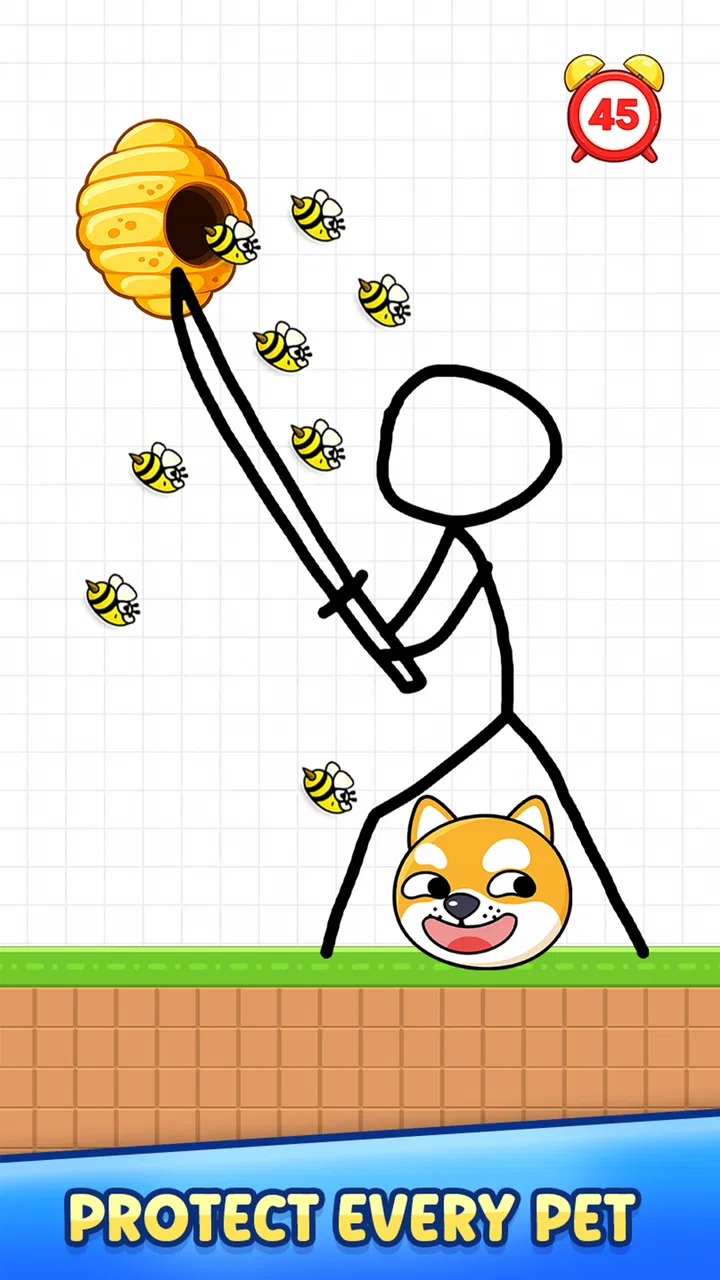
Save The Pets is the kind of puzzle game I open when I want a quick problem to solve rather than a long story or a complicated set of systems to learn. Its central idea is easy to understand: pets are placed in danger, and I have to work out how to protect them. That simple goal gives each level an immediate purpose, while the visual presentation keeps the mood lighter than the situations might suggest.
After spending time with it, I see the game as a good fit for short sessions on an Android phone or tablet. It is free to download, rated for Everyone, and developed by Bravestars Games. The current release is version 3.7.13, and it runs on devices using Android 7.0 or later. Those details make it accessible to a wide range of players, although the free-to-play structure still deserves attention before anyone treats it as a completely uninterrupted experience.
The game has built a sizeable audience, with an average rating of 4.3 from around 166 thousand ratings and more than 10 million installs. That popularity makes sense to me: the rules are approachable, the pet-saving premise is immediately readable, and the puzzles can be picked up without studying a manual. Still, its strongest quality is not simply that it is easy to start. It is the way the art, sound, and pacing support a clear, compact puzzle loop.
You May Also Like

 AccuWeather: Weather Radar
AccuWeather Review: A Quick, Clear Forecast for Everyday Decisions
For everyday plans, the best forecast is the one you can understand quickly. AccuWeather makes rain timing, radar, and local conditions easy to act on, with a few trade-offs.

 Hill Climb Racing
Why Hill Climb Racing Still Turns Crashes Into One More Run
A tiny car, a bumpy hill and one more upgrade: Hill Climb Racing keeps resurfacing because its simple chaos makes every near-miss feel personal.

 AliExpress - Shopping App
AliExpress Makes Global Shopping Feel Personal, but Shoppers Bear the Risk
AliExpress turns a global marketplace into a pocket-sized discovery engine. Its reach is useful, its shopping loop compelling, and its trade-offs easy to miss.

 Lords Mobile: Kingdom Wars
Lords Mobile Is a Kingdom-Building Routine, Not a Quick Match
A case-by-case verdict on the building, battles, device demands, and social commitments that make Lords Mobile rewarding for some players and exhausting for others.

 PDF Scanner app - TapScanner
TapScanner Makes Paperwork Easier to Capture, Check, and Share
TapScanner makes scanning with a phone feel less like a rescue operation and more like a dependable step in getting work done. Its capture tools are useful, though not flawless.

 Block Blast!
 Shows How Much a Puzzle Game Can Leave Out
A quiet grid game shows why puzzle players increasingly value instant clarity, repeatable skill and low-pressure play—and where the genre still needs to catch up.
More From Our News Desk
View All News


A friendly first impression with a clear purpose
My first impression was shaped by the contrast between the cute pets and the urgency of the situations around them. The game does not need a lengthy introduction to explain why I should care. A vulnerable animal on screen gives the puzzle an emotional target, and the visual language tells me quickly that the objective is protection rather than collection, combat, or exploration.
That clarity matters on a mobile device. I can begin a level with a general idea of what needs to happen, inspect the arrangement, and start testing a solution. The appeal is especially strong when I have only a few spare minutes, such as while waiting for an appointment or taking a short break. I do not need to remember a large cast of characters or reconstruct a complicated plot before making progress.
The opening experience also shows one of the game’s limitations. Because the premise is so direct, players looking for a deep narrative world may find the presentation thin. The pets provide the emotional focus, but this is fundamentally a puzzle product, not a story-driven adventure. I would recommend it to someone who enjoys visual problem solving with a playful theme, not to someone expecting character development or a substantial campaign narrative.
Another practical question is whether it is suitable for children. The Everyone rating makes the game broadly approachable, and the friendly animal theme is less intimidating than many puzzle games built around danger. Even so, younger players may need help understanding that a failed attempt is part of the puzzle process rather than a permanent loss. I also would not hand over a device without checking how the optional purchases fit into the household’s rules, since items cost between $0.99 and $1.99 each.
The pets give every puzzle a readable emotional center
A less obvious strength is that the pets make failure easier to interpret. In an abstract match or number puzzle, I may know that I made a mistake without understanding why it mattered. Here, the endangered animal gives the board a concrete focus. I naturally look first at the pet, then at the threats and obstacles that stand between it and safety.
That order of attention helps me form a plan before touching the screen. Instead of making random moves immediately, I can ask what the danger is, which object appears to control it, and whether a protective action might create a new problem elsewhere. This is a useful habit for new players: study the relationship between the pet and the hazard before chasing the most obvious move.
The approach also makes the game approachable for families who want something more thoughtful than a purely reflex-based app. A parent can understand the objective by looking at the screen, and a child can explain what they are trying to do without using specialized puzzle vocabulary. The trade-off is that experienced puzzle fans may recognize the basic structure quickly and want more variety than the gentle presentation initially suggests.
Art direction that keeps danger playful
The visual direction works because it avoids making the setting feel genuinely grim. The animals are the focus, and the surrounding danger is presented in a way that supports quick recognition rather than fear. I can read the scene as a small visual problem: this is the pet, this is the threat, and these are the elements I need to understand.
That readability is more important than visual spectacle here. A puzzle can become frustrating when decoration competes with the objects that determine the solution. Save The Pets benefits from a softer, more immediately legible mood. I am encouraged to inspect the scene instead of rushing through it, and the friendly tone makes repeated attempts feel less punishing.
There is a subtle pacing benefit in this art direction. Since the game is not asking me to absorb a large fictional setting, visual information can be processed in short bursts. I can play with the sound low, glance at the board, and still understand the basic situation. That makes it useful in public spaces or shared rooms where I may not want an intense, attention-demanding game.
A setting built from situations rather than lore
The world of the game is expressed through the problems the pets face, not through a large map or an elaborate backstory. Each scene functions like a small stage. Its identity comes from the arrangement of danger, the position of the animal, and the actions I need to consider. This keeps the focus on the puzzle’s immediate question: how can I turn this particular situation into a safe one?
I like that economy, but it also defines who should skip the game. If you want to explore a connected world, unlock locations, or follow a narrative with recurring characters, this will probably feel limited. The setting is there to frame the mechanics and establish a mood. It is not trying to compete with a role-playing game or a story adventure.
For me, that restraint helps the game stay coherent. The cute presentation is not separate from the puzzle design; it prepares me to approach each challenge with curiosity rather than anxiety. The pets are not just decorative mascots placed on top of unrelated mechanics. They give the player a reason to examine the scene carefully.
Sound, rhythm, and the feel of each attempt
Sound plays a supporting role in the experience rather than taking over. The game’s mood is primarily established by its visual language and the clear rescue objective, while audio helps give actions and outcomes a sense of rhythm. I find that this is the right balance for a mobile puzzle: the sound should make the board feel responsive without becoming more important than the decision I am making.
The pacing is similarly restrained. I am not pushed into a constant stream of rapid reactions. The better approach is to pause, inspect, try a move, and learn from the result. That rhythm makes the game feel closer to a visual logic exercise than an arcade challenge. It also means that the most satisfying moments come from recognizing a relationship I missed earlier, not from tapping faster than before.
This creates a useful everyday scenario. If I have a short break between tasks, I can play one or two levels and stop without feeling that I have abandoned a long-running session. If I make a mistake, I can treat the next attempt as a small experiment: change one part of the plan, watch what happens, and refine the solution. That makes the game more comfortable for casual players than puzzle titles that depend on maintaining a long chain of concentration.
Why the slower rhythm can be a strength
Many mobile puzzle alternatives are built around speed, streaks, matching patterns, or repeated rounds that reward constant input. Save The Pets offers a different kind of engagement. Its rescue framing encourages me to think about consequences. A move is valuable not because it is quick, but because it changes the situation in a useful way.
That difference makes it a better choice when I want to unwind without becoming mentally passive. I still need to reason through the level, but the game does not make me feel as if I am competing against the clock every second. It is also easier to share with another person: one player can suggest a plan, while the other performs the move and observes the result.
The downside is that players who enjoy rapid feedback may interpret the same rhythm as slow. If your favorite puzzle games are built around fast combos or demanding timers, the protective scenario may not provide enough intensity. I would choose a traditional match-three game for a quick burst of colorful action, but I would choose this one when I want the board to reward observation and restraint.
How to use the rhythm to solve more consistently
My most useful habit is to separate looking from acting. I first identify the pet’s immediate danger, then inspect whether the obvious solution might expose the animal to another threat. Only after that do I make a move. This sounds basic, but the game’s friendly appearance can tempt me to tap quickly and assume the first visible answer is correct.
A second helpful approach is to treat failed attempts as information. Instead of restarting with a completely different idea, I compare the failed move with the intended result. Did it remove the danger but leave the pet trapped? Did it protect one area while creating a new route for the hazard? This method turns the game into a sequence of small deductions rather than a guessing exercise.
I also recommend playing with enough attention to notice the board’s visual hierarchy. The pet should remain the anchor of the scene, while secondary objects may be there to distract or to suggest a tempting but incomplete action. When I focus on the final safe position rather than the first obstacle I notice, my solutions become more deliberate.
Where the mechanics fit—and where they do not
The mechanics fit the theme because the objective and the action are connected. I am not solving an unrelated puzzle while a pet happens to appear in the background. The level asks me to protect an animal, so I naturally judge each move by whether it improves the pet’s safety. That connection gives the game more personality than a generic collection of boards with a pet sticker added afterward.
At the same time, the simple premise does not automatically make every puzzle equally satisfying. The best moments come when the level makes me reconsider the order of my actions or notice a consequence that is not immediately obvious. A weaker moment occurs when the answer feels like trial and error rather than a conclusion I could reach through careful observation. My enjoyment depends heavily on whether the challenge feels logically readable.
This is why I would not describe the game as a universal replacement for every puzzle app. It is a focused experience with a particular mood. Players who want word puzzles, mathematical challenges, or large-scale strategic planning should look elsewhere. Players who like compact visual problems and a gentle rescue theme are much more likely to appreciate the way the mechanics and presentation reinforce each other.
Free access and the practical cost of playing
The free price makes it easy to test the game without committing money upfront. That is useful because the appeal is personal: some players will immediately enjoy the pet-saving structure, while others may find it too simple or too dependent on repeated attempts. I prefer this kind of low-risk introduction, especially for a family deciding whether the game suits a younger player.
However, free access does not mean the experience is automatically free of friction. Optional purchases are available, priced from $0.99 to $1.99 per item. I would keep that in mind if the device is shared or if a child is playing independently. The safest practical approach is to decide in advance whether purchases are allowed, rather than making that decision in the middle of a difficult level.
The game’s large install base and strong average rating suggest that its basic loop works for many people, but popularity should not replace personal judgment. I would install it for a player who wants an approachable puzzle with a clear emotional hook. I would skip it for someone who dislikes free-to-play structures, wants a completely uninterrupted premium experience, or prefers puzzles with a more demanding intellectual depth from the first minute.
Who gets the most from this particular puzzle
Save The Pets is especially suitable for casual players, younger audiences who enjoy animals, and adults who want a low-pressure game for short breaks. It can also work well as a shared activity because the objective is visible enough for another person to offer suggestions. The game does not require me to explain a complicated economy or memorize a long set of rules before someone else can join the conversation.
It is less suitable for players who need a strong story, competitive rankings, or a sense of building a persistent world. The pet theme may attract those players at first, but the real product is the puzzle decision itself. Anyone expecting the animals to develop as characters or the setting to expand into a detailed adventure should adjust those expectations before downloading.
Compared with ordinary match-based puzzle games, this one feels more situational and less focused on pattern repetition. Compared with physics or logic titles, it presents the challenge in a warmer, more emotionally readable package. That middle position is its identity: it is gentler than a high-pressure arcade puzzle, but more purposeful than a purely decorative casual game.
My final view of the atmosphere and the playability
What stays with me is the coherence between the presentation and the playable mood. The art makes the pets easy to care about, the setting frames each level as a small rescue problem, and the sound and pacing leave room for thought. None of those elements needs to overwhelm the mechanics. They work because they guide my attention toward the animal and the consequences of each action.
There are clear boundaries. The game is not a deep narrative experience, and its free-to-play format may not suit everyone. Its relaxed rhythm can also feel underpowered for players who want speed or constant escalation. Those are not minor details; they determine whether the game belongs on your device.
For me, the strongest recommendation is simple: try it when you want a friendly, focused puzzle that can fit into an ordinary day. Approach each level by observing the danger, considering the order of actions, and treating mistakes as clues rather than failures. If that style sounds enjoyable, Save The Pets is a charming choice for thoughtful short sessions. Bravestars Games has created a game whose best quality is not complexity, but the way its visual warmth and measured rhythm make a straightforward rescue objective feel inviting.
FAQs for Save The Pets
01What is the main objective of Save The Pets?
Save The Pets is a puzzle-based game where the primary goal is to rescue various animals trapped in challenging scenarios. Players must solve puzzles, navigate obstacles, and use strategic thinking to safely guide the pets to freedom. The game offers a mix of fun and mental stimulation, ideal for puzzle enthusiasts.
02Is Save The Pets suitable for children?
Yes, Save The Pets is designed to be family-friendly and suitable for children. The game features bright graphics and engaging puzzles that are appropriate for younger audiences. However, parental guidance is recommended to ensure that children fully understand the game's mechanics and objectives.
03Does Save The Pets require an internet connection to play?
Save The Pets can be played offline, which makes it convenient for users without constant internet access. However, certain features, such as leaderboard updates or in-game purchases, may require an internet connection to function properly. This flexibility allows for uninterrupted gameplay in various settings.
04Are there in-app purchases in Save The Pets?
Yes, Save The Pets offers in-app purchases. Players can buy additional lives, power-ups, or special items to enhance their gaming experience. While these purchases can help progress through the game more quickly, they are optional, and players can still enjoy the game without spending real money.
05What devices are compatible with Save The Pets?
Save The Pets is available on both Android and iOS platforms. It has been optimized to run smoothly on a wide range of devices, including smartphones and tablets. To ensure the best experience, users should check the app's compatibility with their device's specifications before downloading.
Pros
- Engaging puzzles keep players hooked.
- Cute graphics appeal to all ages.
- Frequent updates with new levels.
- Easy to learn controls for beginners.
- Offline play available for convenience.
Cons
- In-app purchases can get pricey.
- Ads interrupt gameplay frequently.
- Some levels feel repetitive.
- Limited customization options.
- Battery drains quickly during play.

Save The Pets
Gallery